2026 Saver's Credit Income Limit
For 2026, the Saver's Credit Income Limit figures are $48,500 (Maximum AGI for the 50% credit rate, married taxpayers filing a joint return), $52,500 (Maximum AGI for the 20% credit rate, married taxpayers filing a joint return), $80,500 (Maximum AGI for the 10% credit rate, married taxpayers filing a joint return) and 10 more figures below.
| Item | Married taxpayers filing a joint return | Taxpayers filing as head of household | All other taxpayers |
|---|---|---|---|
| Maximum AGI for the 50% credit rate | $48,500 | $36,375 | $24,250 |
| Maximum AGI for the 20% credit rate | $52,500 | $39,375 | $26,250 |
| Maximum AGI for the 10% credit rate | $80,500 | $60,375 | $40,250 |
Effective 2026-01-01Source: Notice 2025-67 (IRS)Verified 2026-09-03
Highest-tier applicable percentage, Middle-tier applicable percentage, Lowest non-zero-tier applicable percentageSource: United States Code (2024 edition), Title 26 Section 25B (Office of the Law Revision Counsel)Verified 2026-09-03
Maximum eligible contribution per personSource: Form 8880 (2025), Credit for Qualified Retirement Savings Contributions (IRS)Verified 2026-09-03
Compared with 2025
| Item | 2025 | 2026 | Change |
|---|---|---|---|
| Maximum AGI for the 50% credit rate, married taxpayers filing a joint return | $47,500 | $48,500 | +$1,000 (+2.1%) |
| Maximum AGI for the 20% credit rate, married taxpayers filing a joint return | $51,000 | $52,500 | +$1,500 (+2.9%) |
| Maximum AGI for the 10% credit rate, married taxpayers filing a joint return | $79,000 | $80,500 | +$1,500 (+1.9%) |
| Maximum AGI for the 50% credit rate, taxpayers filing as head of household | $35,625 | $36,375 | +$750 (+2.1%) |
| Maximum AGI for the 20% credit rate, taxpayers filing as head of household | $38,250 | $39,375 | +$1,125 (+2.9%) |
| Maximum AGI for the 10% credit rate, taxpayers filing as head of household | $59,250 | $60,375 | +$1,125 (+1.9%) |
| Maximum AGI for the 50% credit rate, all other taxpayers | $23,750 | $24,250 | +$500 (+2.1%) |
| Maximum AGI for the 20% credit rate, all other taxpayers | $25,500 | $26,250 | +$750 (+2.9%) |
| Maximum AGI for the 10% credit rate, all other taxpayers | $39,500 | $40,250 | +$750 (+1.9%) |
| Highest-tier applicable percentage | 50% | 50% | +0% (+0.0%) |
| Middle-tier applicable percentage | 20% | 20% | +0% (+0.0%) |
| Lowest non-zero-tier applicable percentage | 10% | 10% | +0% (+0.0%) |
| Maximum eligible contribution per person | $2,000 | $2,000 | +$0 (+0.0%) |
Maximum AGI for the 50% credit rate
Maximum AGI for the 20% credit rate
Maximum AGI for the 10% credit rate
$24,250$80,500
One dot per column of the table, on a scale running from the smallest of these amounts to the largest. The scale is logarithmic, so that the amounts crowded at the low end stay far enough apart to read. The table states which dot is which.
Who it applies to
Taxpayers who make eligible contributions to a qualified retirement plan or IRA and claim the retirement savings contributions credit (Saver's Credit) on their federal income tax return for tax year 2026.
What changed this year, and why
For 2026, the maximum adjusted gross income a taxpayer may have and still qualify for any Saver's Credit (the retirement savings contributions credit under section 25B) is $80,500 for married taxpayers filing a joint return, $60,375 for taxpayers filing as head of household, and $40,250 for all other taxpayers. In 2025, the corresponding limits were $79,000, $59,250, and $39,500. Section 25B sets three AGI breakpoints for each filing status, not one: for 2026 those are $48,500, $52,500, and $80,500 for a joint return; $36,375, $39,375, and $60,375 for head of household; and $24,250, $26,250, and $40,250 for all other taxpayers.
Common questions
- What happens if a taxpayer's income exceeds the applicable limit?
- Taxpayers whose adjusted gross income exceeds the limit for their filing status do not qualify for any Saver's Credit at all.
- Are there different income tiers within the Saver's Credit?
- Yes. Form 8880 sets three non-zero rate tiers for each filing status, and this record publishes the AGI breakpoint between each one. For a joint return the tiers end at $48,500, $52,500, and $80,500; for head of household at $36,375, $39,375, and $60,375; for all other filers at $24,250, $26,250, and $40,250. Which decimal amount applies inside each tier is read off Form 8880's own table with your filing status and AGI in hand, and it drops to zero once your AGI passes the top figure for your filing status.
Every amount on this page is a published figure rather than yours. The Saver's Credit income headroom takes the number you enter and works it out against them, showing which published figure it used.
Three things that disqualify you even under the income limit
This passage is quoted from the 2025 edition of Form 8880: the IRS had not yet published a 2026 edition when this record's evidence was gathered, so its two year-specific tests describe the 2025 filing rather than 2026. The dependent test moves with the tax year the credit is being claimed for, so for the 2026 Saver's Credit the question is whether the person was claimed as a dependent on someone else's 2026 tax return, not the 2025 return this quote names. The birth-year cutoff moves the same way: Form 8880 always states January 1 of a specific year, and that year advances by one every time the form itself advances by one tax year, so the cutoff that applies for 2026 is one calendar year later than the January 1, 2008 stated here for 2025. The third condition, being a student, names no year of its own and reads the same regardless of which edition of the form states it. Meeting even one of the three conditions disqualifies the person from the credit no matter how low their income is.
The person(s) who made the qualified contribution or elective deferral (a) was born after January 1, 2008; (b) is claimed as a dependent on someone else’s 2025 tax return; or (c) was a student (see instructions).
Form 8880 (2025), Credit for Qualified Retirement Savings Contributions (IRS)
The credit rate falls in steps as income rises
The saver's credit rate is not one fixed percentage across every income level. Form 8880 pulls it from a table with three non-zero tiers, and which tier you land in depends on your adjusted gross income and filing status. The highest tier runs from the lowest incomes up to $48,500 for a married couple filing jointly, $36,375 for a head of household, and $24,250 for all other filers. The middle tier then runs from those amounts up to $52,500, $39,375, and $26,250. The lowest non-zero tier runs from there up to $80,500, $60,375, and $40,250 - the maximum AGI this record publishes for each filing status. Above that ceiling for your filing status, the applicable decimal amount on Form 8880 drops to zero and no credit is available at all. This record identifies the income breakpoints between the tiers; the decimal each tier actually applies has to be read off Form 8880's own table with your filing status and AGI in hand.
9 Enter the applicable decimal amount from the table below.
Form 8880 (2025), Credit for Qualified Retirement Savings Contributions (IRS)
Only the first $2,000 of contributions counts
The saver's credit is based on your qualified retirement savings contributions, but only up to a cap. On Form 8880, you first total your IRA, ABLE, employer plan, and other qualifying contributions, then subtract any recent distributions to arrive at a net contribution amount. The form then instructs you to enter the smaller of that net amount or $2,000 in each column, one for you and one for your spouse if filing jointly. This means that even if you contributed much more than $2,000 to retirement accounts, only $2,000 per person counts toward the credit. The capped amounts from both columns are added together and then multiplied by the applicable decimal amount from the income table to determine your credit. This $2,000 per-person cap ensures that the credit is based on a limited amount of contributions regardless of how much you actually saved.
6 In each column, enter the smaller of line 5 or $2,000 . . . . . . . . . . 6
Form 8880 (2025), Credit for Qualified Retirement Savings Contributions (IRS)
Recent withdrawals cut the contributions you can count
This passage is quoted from the 2025 edition of Form 8880, the most recent one available when this record's evidence was gathered - the IRS had not yet released a 2026 edition. Both year references in it belong to that 2025 filing: the "2025 tax return" whose due date bounds the look-back window, and the "after 2022" floor the window starts at. Form 8880 sets that floor at the year that is three years before the return's own tax year, so it moves forward by one year with every edition of the form. For the 2026 Saver's Credit, the relevant window is distributions received after the year three years before 2026, and before the due date (including extensions) of your 2026 tax return, not the 2025 return this quote names. If married filing jointly, both spouses' distributions in that window count in both columns. The purpose of the rule is to stop a taxpayer from withdrawing retirement savings and then re-contributing the same money just to claim the credit; certain rollovers and returned contributions are excepted.
4 Certain distributions received after 2022 and before the due date (including extensions) of your 2025 tax return (see instructions). If married filing jointly, include both spouses’ amounts in both columns. See instructions for an exception . . . 4
Form 8880 (2025), Credit for Qualified Retirement Savings Contributions (IRS)
The credit cannot exceed the tax you owe
The saver's credit is limited by your tax liability. After calculating the tentative credit amount on Form 8880, you must complete the Credit Limit Worksheet found in the instructions. The worksheet determines how much tax you owe after accounting for other credits. The final credit you can claim is the smaller of the tentative credit or the amount from this worksheet. This means the credit cannot reduce your tax below nothing. If your tax liability is low relative to the tentative credit, your actual credit will be reduced accordingly. The income limits for the credit are $80,500 for married taxpayers filing jointly, $60,375 for head of household, and $40,250 for all other taxpayers, but even if your income is well below these amounts, the credit you receive is still constrained by what you owe in tax.
11 Limitation based on tax liability. Enter the amount from the Credit Limit Worksheet in the instructions 11
Form 8880 (2025), Credit for Qualified Retirement Savings Contributions (IRS)
Being a student for even part of five months can disqualify you
This passage is quoted from the 2025 edition of Form 8880, the most recent one available when this record's evidence was gathered - the IRS had not yet released a 2026 edition. The student test itself is not tied to any one edition of the form; it always asks about the calendar year the credit is being claimed for. So for the 2026 Saver's Credit, the question this quote poses is whether you were enrolled as a full-time student, or took a full-time on-farm training course given by a school or a state, county, or local government agency, during any part of 5 calendar months of 2026, not 2025 as the quote itself states. Meeting that test for even part of five months - say, only from January through May - disqualifies you from the credit entirely, whether it was you or your spouse who made the qualified contribution. Technical, trade, and mechanical schools count as schools for this purpose; on-the-job training, correspondence schools, and online-only programs do not.
You were a student if during any part of 5 calendar months of 2025 you: • Were enrolled as a full-time student at a school; or • Took a full-time, on-farm training course given by a school or a state, county, or local government agency.
Form 8880 (2025), Credit for Qualified Retirement Savings Contributions (IRS)
The form used, and where the credit lands on your return
To claim the 2026 Saver's Credit, you must file Form 8880 (Credit for Qualified Retirement Savings Contributions) with your federal income tax return. The credit amount is calculated on Form 8880 and then flows to Schedule 3 (Form 1040), line 4, where it reduces your tax liability dollar for dollar. Schedule 3 is the form used to claim various nonrefundable credits, and line 4 is specifically designated for the retirement savings contributions credit. The credit is nonrefundable, meaning it can reduce your tax to zero but cannot result in a refund on its own. You must file Form 8880 even if you are not claiming any other credits, and the form must be attached to your Form 1040, 1040-SR, or 1040-NR.
12 Credit for qualified retirement savings contributions. Enter the smaller of line 10 or line 11 here and on Schedule 3 (Form 1040), line 4
Form 8880 (2025), Credit for Qualified Retirement Savings Contributions (IRS)
This credit stacks on top of the separate IRA deduction
The Saver's Credit is separate from and in addition to any IRA deduction you may claim. This means you can both take a tax deduction for your traditional IRA contributions (reported on Schedule 1 (Form 1040), line 20) and receive the Saver's Credit on those same contributions. The two benefits are calculated independently, so the IRA deduction does not reduce the credit amount. You report the IRA deduction on Schedule 1, and you claim the Saver's Credit on Schedule 3 (Form 1040), line 4, using Form 8880 to calculate the credit. For 2026, the credit is available to taxpayers with adjusted gross income up to $80,500 if married filing jointly, $60,375 if head of household, or $40,250 for all other filers.
This credit can be claimed in addition to any IRA deduction claimed on Schedule 1 (Form 1040), line 20.
Form 8880 (2025), Credit for Qualified Retirement Savings Contributions (IRS)
How each figure was verified
Each number below was read from a stored copy of the document named beside it, and checked to occur word for word in the quoted sentence. The digest is of that stored text.
Notice 2025-67 (IRS)
- Maximum AGI for the 50% credit rate, married taxpayers filing a joint return
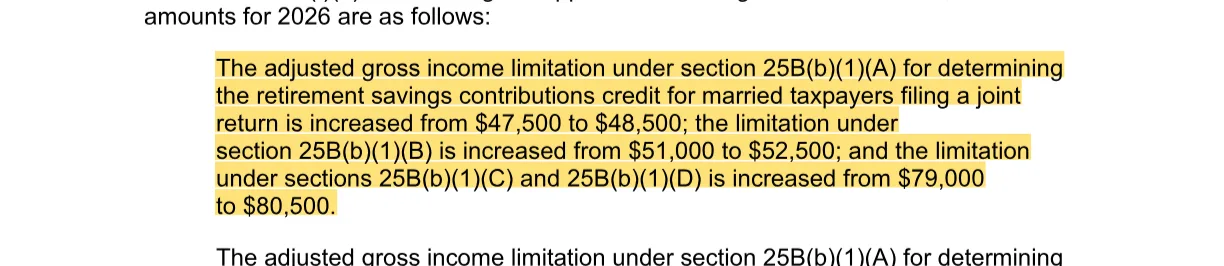
The adjusted gross income limitation under section 25B(b)(1)(A) for determining the retirement savings contributions credit for married taxpayers filing a joint return is increased from $47,500 to $48,500; the limitation under section 25B(b)(1)(B) is increased from $51,000 to $52,500; and the limitation under sections 25B(b)(1)(C) and 25B(b)(1)(D) is increased from $79,000 to $80,500.
- Maximum AGI for the 20% credit rate, married taxpayers filing a joint return
The adjusted gross income limitation under section 25B(b)(1)(A) for determining the retirement savings contributions credit for married taxpayers filing a joint return is increased from $47,500 to $48,500; the limitation under section 25B(b)(1)(B) is increased from $51,000 to $52,500; and the limitation under sections 25B(b)(1)(C) and 25B(b)(1)(D) is increased from $79,000 to $80,500.
- Maximum AGI for the 10% credit rate, married taxpayers filing a joint return
The adjusted gross income limitation under section 25B(b)(1)(A) for determining the retirement savings contributions credit for married taxpayers filing a joint return is increased from $47,500 to $48,500; the limitation under section 25B(b)(1)(B) is increased from $51,000 to $52,500; and the limitation under sections 25B(b)(1)(C) and 25B(b)(1)(D) is increased from $79,000 to $80,500.
- Maximum AGI for the 50% credit rate, taxpayers filing as head of household
The adjusted gross income limitation under section 25B(b)(1)(A) for determining the retirement savings contributions credit for taxpayers filing as head of household is increased from $35,625 to $36,375; the limitation under section 25B(b)(1)(B) is increased from $38,250 to $39,375; and the limitation under sections 25B(b)(1)(C) and 25B(b)(1)(D) is increased from $59,250 to $60,375.
- Maximum AGI for the 20% credit rate, taxpayers filing as head of household
The adjusted gross income limitation under section 25B(b)(1)(A) for determining the retirement savings contributions credit for taxpayers filing as head of household is increased from $35,625 to $36,375; the limitation under section 25B(b)(1)(B) is increased from $38,250 to $39,375; and the limitation under sections 25B(b)(1)(C) and 25B(b)(1)(D) is increased from $59,250 to $60,375.
- Maximum AGI for the 10% credit rate, taxpayers filing as head of household
The adjusted gross income limitation under section 25B(b)(1)(A) for determining the retirement savings contributions credit for taxpayers filing as head of household is increased from $35,625 to $36,375; the limitation under section 25B(b)(1)(B) is increased from $38,250 to $39,375; and the limitation under sections 25B(b)(1)(C) and 25B(b)(1)(D) is increased from $59,250 to $60,375.
- Maximum AGI for the 50% credit rate, all other taxpayers
The adjusted gross income limitation under section 25B(b)(1)(A) for determining the retirement savings contributions credit for all other taxpayers is increased from $23,750 to $24,250; the limitation under section 25B(b)(1)(B) is increased from $25,500 to $26,250; and the limitation under sections 25B(b)(1)(C) and 25B(b)(1)(D) is increased from $39,500 to $40,250.
- Maximum AGI for the 20% credit rate, all other taxpayers
The adjusted gross income limitation under section 25B(b)(1)(A) for determining the retirement savings contributions credit for all other taxpayers is increased from $23,750 to $24,250; the limitation under section 25B(b)(1)(B) is increased from $25,500 to $26,250; and the limitation under sections 25B(b)(1)(C) and 25B(b)(1)(D) is increased from $39,500 to $40,250.
- Maximum AGI for the 10% credit rate, all other taxpayers
The adjusted gross income limitation under section 25B(b)(1)(A) for determining the retirement savings contributions credit for all other taxpayers is increased from $23,750 to $24,250; the limitation under section 25B(b)(1)(B) is increased from $25,500 to $26,250; and the limitation under sections 25B(b)(1)(C) and 25B(b)(1)(D) is increased from $39,500 to $40,250.
United States Code (2024 edition), Title 26 Section 25B (Office of the Law Revision Counsel)
- Highest-tier applicable percentage
if the adjusted gross income of the tax- payer is not over $30,000, 50 percent,
- Middle-tier applicable percentage
if the adjusted gross income of the tax- payer is over $30,000 but not over $32,500, 20 percent,
- Lowest non-zero-tier applicable percentage
if the adjusted gross income of the tax- payer is over $32,500 but not over $50,000, 10 percent,
Form 8880 (2025), Credit for Qualified Retirement Savings Contributions (IRS)
- Maximum eligible contribution per person
In each column, enter the smaller of line 5 or $2,000