Bonus Depreciation Percentage 2026
Current year
The 2026 Bonus Depreciation Percentage is 100%.
Effective 2026-01-01Source: Notice 2026-11 (IRS)Verified 2026-09-02
Compared with 2025
Every figure on this page is unchanged from 2025.
| Item | 2025 | 2026 | Change |
|---|---|---|---|
| Special depreciation allowance | 100% | 100% | +0% (+0.0%) |
Who it applies to
Taxpayers who acquire and place in service qualified property, or who plant or graft specified plants, for which a § 168(k) additional first year depreciation deduction is available.
What changed this year, and why
For 2026, the special depreciation allowance (bonus depreciation) under § 168(k) is 100 percent, effective for qualified property acquired after January 19, 2025, as provided by the One, Big, Beautiful Bill Act (OBBBA).
Common questions
- What is the bonus depreciation percentage for 2026?
- For 2026, the bonus depreciation percentage (special depreciation allowance) under § 168(k) is 100 percent, as set by the One, Big, Beautiful Bill Act for qualified property acquired after January 19, 2025.
What the percentage is applied to, and what is left afterwards
This passage explains the mechanical relationship between the special depreciation allowance (bonus depreciation) and regular MACRS depreciation. After you calculate the bonus depreciation amount for your qualified property or qualified production property, the remaining cost - that is, the original cost minus the allowance - becomes the basis on which you compute regular MACRS depreciation. In practical terms, you must first subtract the special depreciation allowance from the property's depreciable basis before applying the applicable MACRS rate to what is left. For 2026, the special depreciation allowance is 100%. Because the allowance is taken upfront, the basis available for year-by-year regular depreciation is reduced by that same 100% amount. Once the full 100% allowance has been deducted in the year the property is placed in service, there is no remaining cost left to depreciate under MACRS for that asset. The passage makes clear that the two steps are sequential: figure the allowance first, reduce basis, then figure regular depreciation on the reduced amount.
Depreciating the remaining cost. After you figure your special depreciation allowance for your qualified property or qualified production property, you can use the remain- ing cost to figure your regular MACRS depreciation de- duction (discussed in chapter 4). Therefore, you must re- duce the depreciable basis of the property by the special depreciation allowance before figuring your regular MACRS depreciation deduction.
Publication 946 (2025), How To Depreciate Property (IRS)
Electing out, by class of property
Taxpayers are not required to take the special depreciation allowance if they prefer to depreciate the entire cost of their property over time under regular MACRS. The IRS permits an election to opt out, but the election must be made on a class-by-class basis. You cannot pick and choose individual assets; you must elect out for every item of property that falls within the same asset class placed in service during that tax year. To make the election, you must attach a statement to your tax return that clearly identifies which class of property you are electing out of. Each person who owns qualified property - such as a partnership, an S corporation, or a member of a consolidated group - must make the election separately. The election is generally due on a timely filed return, including extensions, for the year the property is placed in service. Once made, the election is irrevocable without IRS consent.
You can elect, for any class of property, not to deduct any special depreciation allowances for all property in such class placed in service during the tax year.
Publication 946 (2025), How To Depreciate Property (IRS)
Recapture when you dispose of the property
When you sell or otherwise dispose of property for which a special depreciation allowance was previously claimed, the tax code requires you to recapture part or all of the gain as ordinary income rather than capital gain. The recapture amount is limited to the total special depreciation allowance that was allowed or allowable on the property. In other words, you cannot treat as capital gain any portion of the sale proceeds that represents a recovery of the accelerated depreciation you already deducted. For 2026, the special depreciation allowance is 100% of the property's basis, so the recapture potential can be substantial. If you sell the property for more than its original cost, any gain above the amount of the special depreciation allowance may qualify for capital gain treatment, but the portion of gain equal to the allowance is always ordinary income. Taxpayers should consult the rules on MACRS depreciation recapture for detailed guidance on calculating the recapture amount.
When you dispose of property for which you claimed a special depreciation allowance, any gain on the disposi- tion is generally recaptured (included in income) as ordi- nary income up to the amount of the special depreciation allowance previously allowed or allowable.
Publication 946 (2025), How To Depreciate Property (IRS)
Lease the building to someone else running the production activity, and you generally do not qualify
If you own a building and lease it to another party that carries out a qualifying production activity (QPA) inside it, you generally do not qualify for the special depreciation allowance on that property. The special allowance is intended for the taxpayer that is itself conducting the qualifying production activity, not for a passive lessor. This means that even though the building may otherwise be qualifying production property (QPP) because a QPA takes place within it, the act of leasing it to the operator removes your eligibility. The rule looks at who is performing the manufacturing, production, or similar activity that transforms the product; the person doing that work - not the landlord - claims the allowance. If only a portion of the building is used for a QPA, the depreciable basis of the eligible property you may designate as QPP can be less than the building's overall depreciable basis, but the leasing-out disqualification applies regardless of how much space the tenant uses.
If you lease property to some- one else that conducts a QPA within it, you generally do not qualify for the special depreciation allowance.
Publication 946 (2025), How To Depreciate Property (IRS)
Both the date you acquired the property and the date you placed it in service decide which percentage applies
The percentage of the special depreciation allowance you can claim depends on when you acquired the property and when you placed it in service. For certain qualified property acquired and placed in service after January 19, 2025, the IRS requires you to take a 100% special depreciation allowance unless you elect out. If you prefer a lower first-year deduction, you may instead elect to take a reduced percentage for that property in the first tax year ending after January 19, 2025. Both dates matter: the property must be acquired and placed in service after that January 19, 2025 date for the 100% rate to apply. Qualified property generally includes tangible property depreciated under MACRS, certain computer software, water utility property, and qualified film, television, live theatrical, and sound recording productions. Because both the acquisition date and the placed-in-service date must fall after the threshold, property bought before that date but placed in service afterward - or vice versa - falls under the earlier, lower percentage schedule instead.
Unless you elect out, you must take a 100% special de- preciation allowance for certain qualified property (includ- ing long production period property and certain aircraft) acquired and placed in service after January 19, 2025.
Publication 946 (2025), How To Depreciate Property (IRS)
Basis the passenger-auto cap kept you from deducting is not lost - it continues after the recovery period
When you claim the special depreciation allowance on a passenger automobile, the annual depreciation caps may prevent you from deducting the full cost of the vehicle during the standard recovery period. The portion of the cost that those limits keep you from deducting does not vanish. If the depreciation deductions for your automobile are reduced under the passenger automobile limits, you will have unrecovered basis in your automobile at the end of the recovery period. If you continue to use the automobile for business, you can deduct that unrecovered basis after the recovery period ends. You can claim a depreciation deduction in each succeeding tax year until you recover your full basis in the car, subject each year to the same maximum deduction amount that applies based on the date you placed the car in service. In other words, the basis the passenger-auto cap kept you from writing off is preserved and carried forward, not forfeited.
If the depreciation deductions for your automobile are re- duced under the passenger automobile limits, you will have unrecovered basis in your automobile at the end of the recovery period. If you continue to use the automobile for business, you can deduct that unrecovered basis after the recovery period ends.
Publication 946 (2025), How To Depreciate Property (IRS)
How each figure was verified
Each number below was read from a stored copy of the document named beside it, and checked to occur word for word in the quoted sentence. The digest is of that stored text.
Notice 2026-11 (IRS)
- Special depreciation allowance
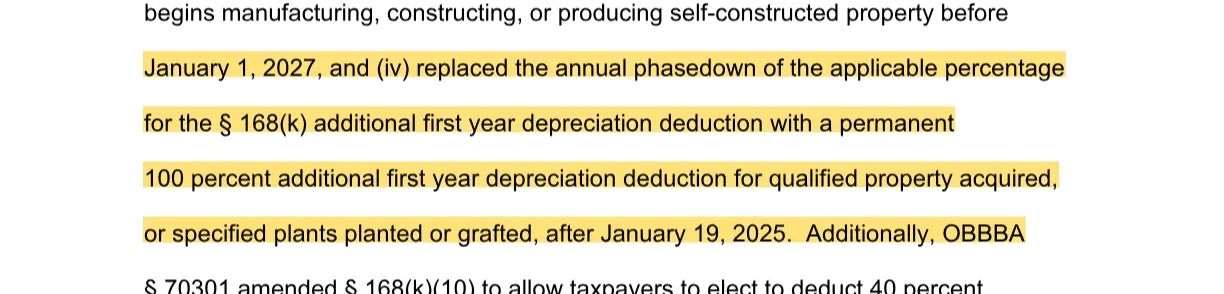
replaced the annual phasedown of the applicable percentage for the § 168(k) additional first year depreciation deduction with a permanent 100 percent additional first year depreciation deduction for qualified property acquired, or specified plants planted or grafted, after January 19, 2025.
By year
Every published year
11 years on record, 2026 back to 2016. Each year links to its own page, its own document and its own verification date.
Oldest year at the left. Every line spans the same run of years, with a tick under each year it has a figure for, so a line that starts late is a column the law added late. The vertical axis is scaled to the values plotted rather than to zero, so a line shows the shape of the change and not the size of the amount. The table states every value.
Download every year as a csv. One row per published figure, each carrying the document it was read from and the date it was checked.
The same calculator for another year
- 2024 First-year bonus depreciation on an asset
- 2023 First-year bonus depreciation on an asset
- 2022 First-year bonus depreciation on an asset
- 2021 First-year bonus depreciation on an asset
- 2020 First-year bonus depreciation on an asset
- 2019 First-year bonus depreciation on an asset
- 2018 First-year bonus depreciation on an asset
- 2017 First-year bonus depreciation on an asset