2026 Child and Dependent Care Credit
For 2026, the Child and Dependent Care Credit figures are 50% (Maximum rate), $3,000 (Expense limit, one person) and $6,000 (Expense limit, two or more people).
Effective 2026-01-01Source: Publication 505 (2026), Tax Withholding and Estimated Tax (IRS)Verified 2026-09-03
Compared with 2025
| Item | 2025 | 2026 | Change |
|---|---|---|---|
| Maximum rate | 35% | 50% | +15% (+42.9%) |
| Expense limit, one person | $3,000 | $3,000 | +$0 (+0.0%) |
| Expense limit, two or more people | $6,000 | $6,000 | +$0 (+0.0%) |
Who it applies to
The credit is for a person who pays for the care of a qualifying person so that they, and their spouse if filing jointly, can work or look for work. A qualifying person is your dependent child who was under age 13 when the care was provided, your spouse who was not physically or mentally able to care for themselves and lived with you for more than half the year, or another person unable to care for themselves who lived with you for more than half the year and either was your dependent or would have been but for their gross income, a joint return, or your own dependent status. You and your spouse must have earned income during the year, the payments cannot go to your spouse, to someone you can claim as a dependent, to your own child who was under age 19 at the end of the year, or to the parent of your qualifying child, and you must identify the care provider on your return. Married couples generally must file jointly, though a spouse who is legally separated or living apart under conditions similar to prior years can still claim it.
What changed this year, and why
For 2026, the maximum credit rate for the Child and Dependent Care Credit rises from 35% to 50%. The expense limits remain $3,000 for one qualifying person and $6,000 for two or more qualifying persons. The 50% figure is the top of a sliding scale: the percentage that actually applies to you depends on your adjusted gross income and steps down as that income rises, the same structure that applied when the top rate was 35%. The credit remains limited to your tax, with no refund of any excess.
Common questions
- What is the maximum credit rate for 2026?
- The maximum credit rate is 50% of qualifying expenses for 2026, up from 35% in 2025. This is the top of a sliding scale, not a flat rate available to every taxpayer.
- How much can I count in qualifying expenses?
- You may count up to $3,000 of qualifying expenses for one qualifying person, or up to $6,000 for two or more qualifying persons. Your expenses are also capped by your earned income.
- Why is my dependent care credit less than 50% of what I paid?
- 50% is the top of a sliding scale. The percentage that actually applies to you depends on your adjusted gross income: it is highest at the lowest incomes and steps down as income rises, flattening out at a floor rate that applies to everyone above the top band. Other limits sit on top of that as well: the cap on countable expenses, and the earned income limit, which caps expenses at your earned income or the smaller of yours and your spouse's earned income if you are married.
Every amount on this page is a published figure rather than yours. The Dependent care expense headroom takes the number you enter and works it out against them, showing which published figure it used.
The credit cannot exceed what you earned
Even if you paid substantial work-related expenses, the amount you can use to calculate the credit is capped by your earned income for the year. If you are single at the end of the year, your credit base cannot exceed what you personally earned. If you are married at the end of the year, the limit is the smaller of your earned income or your spouse's earned income for the year. Importantly, when applying this married couple rule, you must use your spouse's earned income for the entire year, even if you were married for only part of the year. This prevents married couples from using more than the lower earner actually produced to figure the credit. The earned income considered for this purpose is the same definition used for the separate "You Must Have Earned Income" test described elsewhere in the publication.
Earned Income Limit The amount of work-related expenses you use to figure your credit can't be more than: 1. Your earned income for the year if you are single at the end of the year, or 2. The smaller of your or your spouse's earned income for the year if you are married at the end of the year.
Publication 503 (2025), Child and Dependent Care Expenses (IRS)
The exception for a student or disabled spouse
When one spouse has little or no earned income, that lower income could shrink or eliminate the credit because of the earned-income limit. The publication provides a special rule to prevent this: a spouse who is a full-time student, or who is physically or mentally unable to care for themselves, is treated as having earned income for each month they meet that condition. To qualify, the spouse must also have lived with the taxpayer for more than half the year. On a joint return, the rule can also apply to the taxpayer. This deemed-earned-income treatment allows the couple to use a higher expense limit when figuring the credit, preserving the benefit even though one spouse did not work during the year. Without this rule, a working spouse with a full-time-student or disabled spouse could lose the credit entirely because the lower-earning spouse's actual earned income would be zero.
Rule for student-spouse or spouse not able to care for self. Your spouse is treated as having earned income for any month that they are: 1. A full-time student, or 2. Physically or mentally not able to care for themselves. (Your spouse must also live with you for more than half the year.)
Publication 503 (2025), Child and Dependent Care Expenses (IRS)
Married couples generally must file jointly
The child and dependent care credit is generally available only to taxpayers who file a joint return when they are married. If you are married at the end of the year, your filing status must typically be married filing jointly to claim the credit. The acceptable filing statuses for taking the credit are single, head of household, or qualifying surviving spouse. Married couples who choose married filing separately are, as a rule, ineligible. An exception exists for certain married taxpayers who lived apart from their spouse and meet specific conditions; those exceptions are described under the filing-status section of the publication. The joint-return requirement ensures that both spouses' income is taken into account when the credit is computed, which matters because the credit's expense base is limited to the lower earned income of the two spouses.
5. Joint Return Test. Your filing status may be single, head of household, or qualifying surviving spouse. If you are married, you must file a joint return, unless an exception applies to you. See What’s Your Filing Sta- tus, later.
Publication 503 (2025), Child and Dependent Care Expenses (IRS)
You must name the provider, or show due diligence
Every care provider - whether an individual, a daycare center, or another organization - must be identified on the taxpayer's return using Form 2441, Part I. The information required is the provider's name, address, and taxpayer identification number. For an individual provider, that number is a social security number or individual taxpayer identification number; for an organization, it is the employer identification number. Tax-exempt organizations such as churches or schools are an exception: instead of a number, the taxpayer writes "Tax-Exempt." If the taxpayer cannot supply complete or correct information, the credit may be disallowed unless the taxpayer can demonstrate due diligence in trying to obtain it. Due diligence is shown by keeping records such as a completed Form W-10 or another acceptable source of the provider's details. If the provider refuses to provide the information, the taxpayer reports whatever is known, attaches a statement explaining the refusal, and that statement itself serves as evidence of due diligence.
Care Provider Identification Test You must identify all persons or organizations that provide care for your child or dependent. Use Form 2441, Part I, to show the information.
Publication 503 (2025), Child and Dependent Care Expenses (IRS)
Employer benefits shrink the expense limit
If your employer provides dependent care benefits that you exclude or deduct from your income, the amount excluded or deducted reduces the dollar limit you can use to figure the credit. The normal dollar limits are $3,000 for one qualifying person and $6,000 for two or more qualifying persons. Any tax-free or deductible benefits received under a qualified employer plan must be subtracted from whichever limit applies to you. The reduced dollar limit is computed on Form 2441, Part III. This means employer-provided benefits and the credit share a single ceiling: you cannot use the same dollars both to receive a tax-free benefit and to generate a credit. The dollar limit is reduced dollar for dollar by the amount of benefits excluded or deducted, so the remaining expense base for the credit may be smaller than the full limit, or may even be reduced to zero if the excluded benefits equal or exceed the applicable limit.
Reduced Dollar Limit If you received dependent care benefits that you exclude or deduct from your income, you must subtract that amount from the dollar limit that applies to you. Your re- duced dollar limit is figured on Form 2441, Part III. See Dependent Care Benefits, earlier, for information on ex- cluding or deducting these benefits.
Publication 503 (2025), Child and Dependent Care Expenses (IRS)
Expenses count in the year you pay them, not the year care happened
For the federal Child and Dependent Care Credit, expenses count toward the credit in the year you actually pay them, not the year the care was provided. If you had qualifying work-related expenses in one year but didn't pay for them until the following year, you cannot claim them on your return for the year the care occurred. Instead, you must treat them as expenses of the year you paid. For example, if you incurred care expenses in 2024 but didn't pay them until 2025, you cannot include them when calculating your 2024 credit. However, you may be able to claim them on your 2025 return if you didn't already use the maximum amount of qualified expenses for 2024. The expense limits for 2026 are $3,000 for one qualifying person and $6,000 for two or more qualifying persons, and the maximum credit rate is 50%. To figure the credit for prior-year expenses paid in the current year, you must complete Worksheet A in the Instructions for Form 2441.
Payments for prior-year expenses. If you had work-re- lated expenses in 2024 that you paid in 2025 and you didn't claim a credit on the maximum amount of qualified expenses for 2024, you may be able to increase the amount of the credit you can take in 2025.
Publication 503 (2025), Child and Dependent Care Expenses (IRS)
The credit can only offset tax you owe, not add to your refund
The federal Child and Dependent Care Credit is nonrefundable: it can reduce your tax liability to zero but cannot produce a refund beyond what you owe. This means if the credit amount you calculate exceeds your total tax for the year, the excess is simply lost - it is not paid out to you and it does not carry forward. You enter the credit on Schedule 3 (Form 1040), line 2, but the actual benefit is capped at the amount of tax shown on your return. For 2026, the expense limits used to compute the credit are $3,000 for one qualifying person and $6,000 for two or more, and the maximum credit rate is 50%. Even when those figures produce a large credit, the final amount you receive cannot exceed your tax. The Instructions for Form 2441 provide more information on how this limitation applies to your situation.
The amount of credit you can claim is limited to your tax. You can't get a refund for any part of the credit that is more than this limit.
Publication 503 (2025), Child and Dependent Care Expenses (IRS)
Wrong or missing provider information can cost you the credit
When you claim the federal Child and Dependent Care Credit, you must provide accurate information about each care provider, including name, address, and taxpayer identification number. The IRS verifies this information, and if what you report is incorrect or incomplete, your credit may be disallowed entirely. However, if you can demonstrate that you exercised due diligence in trying to obtain and supply the correct provider details, you may still claim the credit even if the information turns out to be wrong. You can show due diligence by keeping a completed Form W-10 from the provider, or by retaining another reliable source such as a recently printed letterhead or invoice that shows the provider's name, address, and TIN. Do not send Form W-10 to the IRS - keep it with your tax records. Providers themselves can be penalized for failing to supply their information or for giving incorrect details, but that does not protect you if you did not make a reasonable effort to collect it.
Due diligence. If the care provider information you give is incorrect or incomplete, your credit may not be allowed. However, if you can show that you used due diligence in trying to supply the information, you can still claim the credit.
Publication 503 (2025), Child and Dependent Care Expenses (IRS)
How each figure was verified
Each number below was read from a stored copy of the document named beside it, and checked to occur word for word in the quoted sentence. The digest is of that stored text.
Publication 505 (2026), Tax Withholding and Estimated Tax (IRS)
- Maximum rate
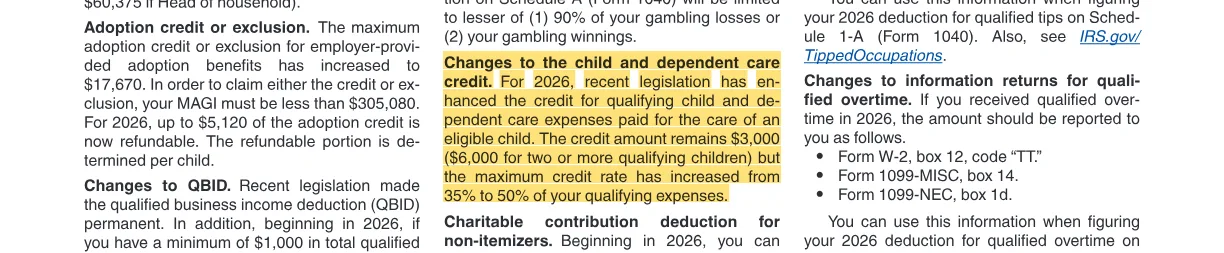
Changes to the child and dependent care credit. For 2026, recent legislation has en- hanced the credit for qualifying child and de- pendent care expenses paid for the care of an eligible child. The credit amount remains $3,000 ($6,000 for two or more qualifying children) but the maximum credit rate has increased from 35% to 50% of your qualifying expenses.
- Expense limit, one person
Changes to the child and dependent care credit. For 2026, recent legislation has en- hanced the credit for qualifying child and de- pendent care expenses paid for the care of an eligible child. The credit amount remains $3,000 ($6,000 for two or more qualifying children) but the maximum credit rate has increased from 35% to 50% of your qualifying expenses.
- Expense limit, two or more people
Changes to the child and dependent care credit. For 2026, recent legislation has en- hanced the credit for qualifying child and de- pendent care expenses paid for the care of an eligible child. The credit amount remains $3,000 ($6,000 for two or more qualifying children) but the maximum credit rate has increased from 35% to 50% of your qualifying expenses.